The day we arrived in Hill City, we immediately headed out to check out the local tunnel, but before we left, we had to measure the width of our truck. Why? Because the sign says the tunnel is 8’6” wide. Luckily our truck is only 8’2” wide- no problem, two whole extra inches on each side!
 We stopped just before going through the tunnel to climb on the nearby rocks for about an hour. Both Paul and I enjoy rock scrambling, and there are some awesome rocks here. (our truck is actually in this picture).
Once we tired of that, we stood and watched other vehicles come through the tunnel for a while. Apparently we just missed seeing a tour bus squeak through.
And finally, it was our turn!


I walked behind the truck through the tunnel- its not like there was going to be a traffic issue, although, a car came right behind me, happy to use our dually to keep people out of his way! Once inside, Paul had a great time, but scared the wits out of everyone nearby when he blasted the air horns.
Custer State Park contains Harney Peak, the tallest peak between the Rockies and the Swiss Alps. We hiked an 8 mile loop, eating lunch once we made it to the peak.

We were tired on the way down, and debated taking the short spur that would lead us to Little Devil’s Tower, and we decided we had come to far to pass that close without seeing it, so up we went.


Wind Cave National Park:
The story of how Wind Cave became available to become a National Park is kind of funny ( but not to those involved at the time, I bet). In 1889, The mineral rights for the land belonged to South Dakota Mining Co. They hired J.D. McDonald to oversee the cave, and had him file a homesteading claim on the land to keep anyone else from gaining access to it. J.D.’s teenage son Alvin spent most of his time exploring, mapping and giving tours of the cave. Sadly, he died at the age of 20, but he left behind comprehensive maps of what he found. After the mining company dissolved a few years later, the McDonald family expanded the touring business and took on a partner. Over the next several years, more and more arguments broke out between the partners, and eventually they both claimed they owned the property. They made the unfortunate mistake of taking their battle to court, and the court decided that NEITHER partner had filed an appropriate claim, and ruled that the land would revert back to government ownership. In 1903 it was turned into a national park. We started our day at Wind Cave by hiking a 5 mile loop. Most of the trail was pretty very prairie land, complete with several bison herds. We even saw a Golden Eagle, although we didn't realize what it was at the time.

The prairie dogs were plentiful and very vocal. They barked from the time we were in sight until we had passed their colony. What I will remember most about the trail though, is that it contained the most poison ivy I have ever seen, and it was impossible to dodge it all. We were both wearing shorts, but we were as careful as we could be, and washed our legs, boots, and sticks when we got back to the truck. I’ve never actually had poison ivy before and it looks like we both escaped the effects of it this time! The afternoon forecast called for high heat and possible thunderstorms, so that's when we headed for Wind Cave itself. With a constant year round temperature of 54 degrees, we put on long pants and grabbed a jacket for our 1.5 hour "Fairgrounds Tour", 240 feet beneath the surface.

Mammoth Site, Hot Springs, SD: In the early 1970s a land developer in Hot Springs, South Dakota, was clearing some land in preparation for building, and came across what appeared to be a ma tusk. He called the paleontology department of a nearby university and asked them to come out and take a look.

 A building was built over the site and a month is spent every year, excavating more of the sinkhole. They know that it is at least 65 feet deep, and to date they have dug down 22 feet. They find so many bones in that one month that it takes them the rest of the year to study and catalog them. If you want to be one of the volunteers that do the digging, you can signup for it.
 Pioneer Museum-Hot Springs, SD

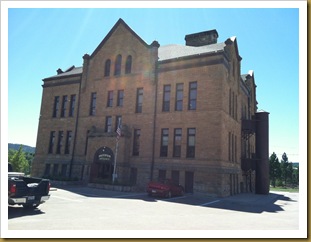
This museum is housed in the old schoolhouse, and I loved the building- with its creaking floor and towering doorways, it reminded me so much of the grammar school that I attended.
Each classroom housed antiques from various aspects of life so many years ago. My favorites rooms were the music room, and the children’s room, which contained the setup for a classroom as well as a display of antique/old toys, some of which I remembered from my childhood.
 Paul’s favorite rooms were the ones that contained the tools and other mechanical items. I think I would keep my hair straight and wet, if these appliances were in use today!
Custer State Park contains Harney Peak, the tallest peak between the Rockies and the Swiss Alps. We hiked an 8 mile loop, eating lunch once we made it to the peak.

We were tired on the way down, and debated taking the short spur that would lead us to Little Devil’s Tower, and we decided we had come to far to pass that close without seeing it, so up we went.

We were glad we did- great views and more rock scrambling!
 |
| View from Little Devil's Tower-Harney Peak is in the distance |

Wind Cave National Park:
The story of how Wind Cave became available to become a National Park is kind of funny ( but not to those involved at the time, I bet). In 1889, The mineral rights for the land belonged to South Dakota Mining Co. They hired J.D. McDonald to oversee the cave, and had him file a homesteading claim on the land to keep anyone else from gaining access to it. J.D.’s teenage son Alvin spent most of his time exploring, mapping and giving tours of the cave. Sadly, he died at the age of 20, but he left behind comprehensive maps of what he found. After the mining company dissolved a few years later, the McDonald family expanded the touring business and took on a partner. Over the next several years, more and more arguments broke out between the partners, and eventually they both claimed they owned the property. They made the unfortunate mistake of taking their battle to court, and the court decided that NEITHER partner had filed an appropriate claim, and ruled that the land would revert back to government ownership. In 1903 it was turned into a national park.
 We started our day at Wind Cave by hiking a 5 mile loop. Most of the trail was pretty very prairie land, complete with several bison herds. We even saw a Golden Eagle, although we didn't realize what it was at the time.
The prairie dogs were plentiful and very vocal. They barked from the time we were in sight until we had passed their colony. What I will remember most about the trail though, is that it contained the most poison ivy I have ever seen, and it was impossible to dodge it all. We were both wearing shorts, but we were as careful as we could be, and washed our legs, boots, and sticks when we got back to the truck. I’ve never actually had poison ivy before and it looks like we both escaped the effects of it this time! The afternoon forecast called for high heat and possible thunderstorms, so that's when we headed for Wind Cave itself. With a constant year round temperature of 54 degrees, we put on long pants and grabbed a jacket for our 1.5 hour "Fairgrounds Tour", 240 feet beneath the surface.

Wind Cave is the 4th longest cave in the world, and has caverns on three different levels. Its best known for its Boxwood formations, so named because the formations on the ceiling resemble open cardboard boxes.
Mammoth Site, Hot Springs, SD: In the early 1970s a land developer in Hot Springs, South Dakota, was clearing some land in preparation for building, and came across what appeared to be a ma tusk. He called the paleontology department of a nearby university and asked them to come out and take a look.

The paleontologist confirmed that it was indeed a Mammoth tusk, approximately 26,000 years old, and said he would need several years to determine if the site was of significant archeological value. Of course, it was, and the developer sold the land to the University for what he paid for it.
The bones of more than 60 mammoths, as well as bones from 65 other species have been found here. 26,000 years ago this area was a sinkhole that partially filled with warm water from a nearby spring. Vegetation surrounded the sinkhole year round, making it appear to be an easy place for a mammoth to grab lunch. However, if they got too close and fell in, the steep, slick walls made it impossible to get back out. Most of the animals found here were young males, and the female guide suggested that had they been willing to ask for directions, they may not have fallen in a hole!
 A building was built over the site and a month is spent every year, excavating more of the sinkhole. They know that it is at least 65 feet deep, and to date they have dug down 22 feet. They find so many bones in that one month that it takes them the rest of the year to study and catalog them. If you want to be one of the volunteers that do the digging, you can signup for it.

This museum is housed in the old schoolhouse, and I loved the building- with its creaking floor and towering doorways, it reminded me so much of the grammar school that I attended.

I wish I had had the fire escape they had on the side of their building though-the round tube contains a spiral slide!
Each classroom housed antiques from various aspects of life so many years ago.
 My favorites rooms were the music room, and the children’s room, which contained the setup for a classroom as well as a display of antique/old toys, some of which I remembered from my childhood.
 Paul’s favorite rooms were the ones that contained the tools and other mechanical items. I think I would keep my hair straight and wet, if these appliances were in use today!


